
Disclosure: we may earn a commission if you buy through links on this page, at no extra cost to you. It never changes our verdict. How we review
Printful is the print-on-demand company to pick when quality and branding matter more than squeezing out the last dollar of margin. It prints most orders in its own facilities, checks every item before it ships, and lets you add your own labels and packaging. You pay for that: base prices run higher than Printify’s, and a $25 t-shirt leaves you less profit than you might expect. Start with a sample order before you list anything.
Printful started the same way a lot of its customers do. Its founders ran a small online shop selling motivational posters, printed them in a living room, and couldn’t find a printer that met their standards once orders picked up. So they built one. That was 2013. Today Printful offers 607 products you can put your designs on, from t-shirts and hoodies to mugs, posters, hats and phone cases, and it says it fulfills more than a million items a month.
We went through Printful’s current pricing, shipping rates, membership plan, printing methods and a few hundred seller reviews to see what you actually get and what it costs. If you’re still choosing a supplier, our best print-on-demand companies guide compares it with the alternatives.
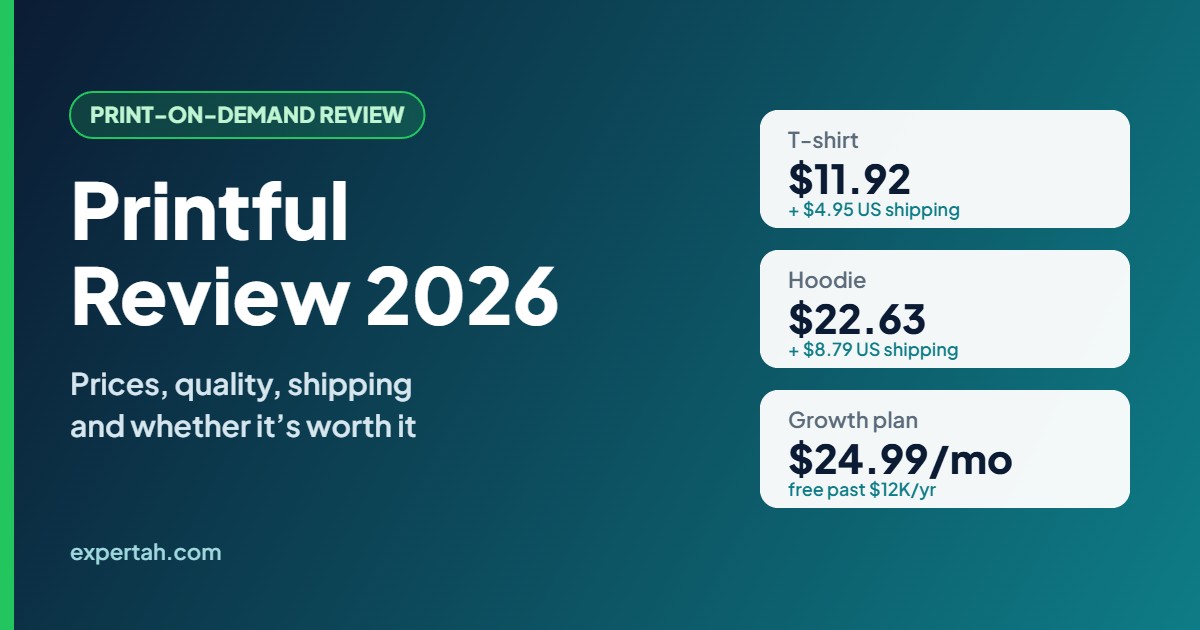
Tees from $11.92, hoodies from $22.63
- Most orders printed in Printful’s own facilities
- 3-step quality check on every item
- Custom labels, pack-ins and branded packaging
- Connects to 20+ store platforms and marketplaces
- Multi-item orders can ship in one package
- Higher base prices than Printify
- Best discounts need the Growth plan
- Delays and stock gaps during peak season
- Support quality is mixed in recent reviews
How Printful works
Printful is a print-on-demand and dropshipping company. You upload a design, put it on a product in Printful’s catalog, and connect your online store. When a customer buys, the order goes to Printful automatically. Printful prints the item, packs it, and ships it to your customer with your store’s name on the package. You never touch inventory.
You set your own retail price. The customer pays you, Printful charges you for the product and shipping, and the difference is yours. Nothing is printed until someone orders, so there’s no stock to sit on and no minimum order.
What separates Printful from most of its competitors is who does the printing. Printify, its biggest rival, is a marketplace: it connects you to dozens of independent print shops, and quality depends on which one you pick. Printful prints most orders in facilities it owns and runs, in Charlotte, Dallas, Cincinnati, Toronto, Tijuana, Riga, Barcelona and Birmingham in the UK, with partner facilities in Australia, Japan and Brazil. One company, one set of standards.
Printful pricing and what you actually make
Signing up is free, and there’s no monthly fee on the free plan. You pay per order, and that cost has three parts: the product’s base price, shipping and sales tax where it applies.
The base price covers the blank item, one print or embroidery placement, and fulfillment. Extras cost more: an inside label is $0.99, an outside label is $2.49, embroidery digitizing is a one-time $2.95 to $6.50 per design, and each extra embroidery placement is $2.95. Here’s what two of the most popular items cost to sell in the US:
| Product | Base price | US shipping (1 item) | Your cost |
|---|---|---|---|
| Bella+Canvas 3001 t-shirt | $11.92 | $4.95 | $16.87 |
| Gildan 18500 hoodie | $22.63 | from $8.79 | $31.42 |
| Each extra shirt in the same order | — | +$2.20 | — |
Printful’s listed prices, checked November 13, 2026, on the free plan. Between October 15, 2026 and January 17, 2027, Printful adds a $0.40 holiday surcharge to every US order.
Now the math most beginners skip. Sell that t-shirt for $25 with “free shipping” and you keep about $8.13 before anything else comes out. Payment processing takes roughly 3% plus 30 cents, and Etsy fees would take more. If you run ads, a single sale can easily cost more than that $8 to win. That’s why many Printful sellers price tees at $28 to $32, lean on hoodies and embroidered hats where the margin in dollars is bigger, or bundle items so the cheaper add-on shipping rate kicks in.
None of that makes Printful a bad deal. You’re paying for in-house printing and a quality check, not just a blank and some ink. But go in knowing that Printful is a quality play, not a cheapest-possible play.
Is Printful Growth worth it?
Printful’s one paid plan, Printful Growth, costs $24.99 a month, comes with a 14-day free trial, and becomes free once your store reaches $12,000 a year in sales. It includes:
- Up to 33% off product prices
- 9% off product branding, such as labels and pack-ins
- 25% off sample orders
- A larger front print on selected products
- Free embroidery digitizing for sample orders
The “up to” matters. The biggest discounts apply to selected products, not the whole catalog, so check the items you actually sell before you pay. As a rough rule: if Growth saves you $1.50 on each of your best sellers, you need about 17 orders a month just to cover the fee. Below that, stay on the free plan. Above it, or once you pass $12,000 a year and it’s free anyway, it’s an easy yes.
The 25% off samples is useful from day one, though. Plenty of sellers start the free trial, order their samples at the discount, and cancel before the trial ends. Printful says it reminds you before the trial runs out.
Printing methods and quality
Printful uses four main printing methods, and which one you get depends on the product:
- DTG (direct-to-garment): ink goes straight into the fabric, like an inkjet printer for clothes. It handles detailed, colorful designs well and feels soft, but colors are a little less punchy on dark shirts.
- DTF (direct-to-film): the design is printed on film and heat-pressed on. It works on sportswear and other fabrics DTG can’t handle, and colors stay bright.
- Embroidery: stitched designs on hats, beanies, polos and hoodies, including 3D puff. This is where Printful has a real edge, because many print-on-demand companies don’t embroider at all.
- All-over print: fabric is printed edge to edge, then cut and sewn into leggings, swimwear, backpacks and similar items.
Every item goes through what Printful calls a 3-step quality check before it ships, and if there’s a manufacturing error, such as a misprint, wrong size or damaged item, Printful reprints it or refunds you at no cost. That consistency is the main reason sellers stay with Printful even though it costs more: the shirt your customer gets in Ohio should look like the shirt that arrived in Texas last month.
It isn’t perfect. Recent reviews still mention the occasional faded print or off-center design, and DTG prints on dark garments will never match screen printing for vibrance. But complaints about print quality are far rarer for Printful than for marketplace-style competitors.
Shipping and fulfillment times
Printful says it takes 2 to 5 business days to make and pack an order, and then shipping time depends on where it’s going. For a t-shirt going to a US address, standard shipping is $4.95 for the first item and $2.20 for each extra one, with delivery in 3 to 6 business days after the order ships. In Europe it’s $4.99, plus $1.45 per extra item. So a realistic promise to US customers is about one to two weeks from order to doorstep.
Because Printful has facilities on several continents, it sends each order from the location nearest your customer, and it says 86% of orders are made in the same region they’re delivered to. That keeps shipping cheaper and faster for buyers in Canada, the UK and the EU than with US-only suppliers. Orders with several items can usually ship together in one box, which cuts your costs and saves your customer from getting three packages on three different days.
The weak spot is peak season. A recurring theme in seller reviews is slower production in November and December and popular sizes or colors going out of stock. If you sell holiday gifts, set a clear order-by date and give yourself a cushion.
Branding: make it look like your brand
This is Printful’s strongest selling point for anyone building a real brand rather than testing designs. Orders ship in neutral packaging with no Printful branding, and you can add:
- Printed inside neck labels ($0.99 each) and outside labels ($2.49 each)
- Pack-ins such as thank-you cards, flyers and stickers
- Branded packaging on selected products
Growth members get 9% off branding. A printed neck label instead of the manufacturer’s tag is a small detail, but it’s the difference between “a shirt from the internet” and “a shirt from your brand.”
Store integrations
Printful connects to more than 20 platforms, including Shopify, Etsy, WooCommerce, Wix, Squarespace, BigCommerce, Amazon, eBay, TikTok Shop and Ecwid. You can run unlimited stores even on the free plan. Its Shopify app alone has about 4,000 reviews, and the integration is where Printful feels most polished: products sync with mockups, orders flow through automatically, and tracking numbers go back to your store.
If you don’t have a store yet, Shopify is the easiest place to start. Our how to start a print-on-demand store guide walks through the setup.
What sellers say about Printful
Across Shopify, G2, GetApp and Trustpilot, the praise and the complaints are both consistent.
What sellers like: how easy the setup is, how reliably orders flow from the store to Printful without manual work, the mockup and design tools, and print quality that stays the same from order to order. Long-time sellers often mention that they’ve used Printful for years without needing to switch.
What they complain about: slower shipping during busy seasons, products or sizes that go out of stock, prices that make small orders less profitable than expected, and support that’s quick for some people and slow or unhelpful for others. Higher international shipping costs come up too.
The pattern is clear: people rarely leave Printful over quality. They leave over cost, or when a supplier problem hits during their busiest weeks.
Printful vs Printify and Tapstitch
The choice usually comes down to what you’re optimizing for. Our full Printful vs Printify comparison goes deeper, but in short: Printify gives you more products, lower base prices and bigger margins, with quality that varies by print provider. Tapstitch is the pick for heavier, fashion-style clothing at lower prices, but it only does apparel.
Choose Printful if you…
Printful- care most about consistent print quality
- want custom labels and branded packaging
- sell embroidered hats, polos or beanies
- have customers in Europe, the UK or Canada
- want mugs, posters and clothing from one supplier
Choose Printify or Tapstitch if you…
Printify / Tapstitch- need the lowest possible base price
- want 1,300+ products to test (Printify)
- want heavyweight, oversized streetwear (Tapstitch)
- are happy to order samples from several providers
- sell mostly in the US
How to get started with Printful
- Create a free account at Printful. No card is needed until you order.
- Connect your store, or use one of Printful’s Quick Stores if you just want to test a few designs.
- Pick a handful of products, not fifty. A tee, a hoodie and one accessory is plenty to start.
- Design and mock up in the free Design Maker, then push the products to your store.
- Order samples of everything you plan to sell. Start the Growth trial first and you get 25% off them.
- Set prices from your real costs: base price plus shipping plus fees, then add the profit you actually want.
Don’t skip the samples. Seeing the real shirt, checking the print on a dark color and wearing it through a couple of washes tells you more than any review, and the photos you take make far better product images than mockups.
Printful is the safest choice in print-on-demand when you want your products to look the same every time and feel like your own brand. Its own facilities, quality checks, free reprints for mistakes, embroidery and branding options are worth paying for if you’re building something long-term. If your plan depends on the lowest possible cost per shirt, Printify will usually leave you more margin. Either way, it’s free to start, so order a sample and judge it in your hands.
Frequently asked questions
Is Printful free to use?
Yes. There is no monthly fee on the free plan. You pay for the product, shipping and any tax only when a customer orders. The optional Printful Growth plan costs $24.99 a month and becomes free once you reach $12,000 a year in sales.
How much does Printful charge per t-shirt?
A Bella+Canvas 3001 t-shirt costs $11.92 on the free plan, plus $4.95 standard shipping to a US address, so about $16.87 before tax (prices checked November 2026). Growth members can get up to 33% off selected products.
How long does Printful take to ship?
Printful takes 2 to 5 business days to make and pack an order. Standard shipping for a t-shirt to a US address then takes about 3 to 6 business days, so plan on one to two weeks from order to delivery, longer during the holidays.
Is Printful better than Printify?
Printful is better for consistent quality, embroidery and branding because it prints most orders in its own facilities. Printify is usually cheaper and has more products, but quality depends on which print provider you choose.
Does Printful put its logo on packages?
No. Orders ship in neutral packaging without Printful branding, and you can add your own inside or outside labels, pack-ins and branded packaging for an extra fee.
What happens if a Printful order is misprinted?
If there is a manufacturing error, such as a misprint, wrong item or damaged product, Printful reprints the order or refunds you at no cost. Returns for fit or change of mind are handled under your own store policy.

Leave A Comment